This big party was held in the forecourt of the Munich Airport between the Terminal buildings. Amazing. And completely free and open to all.
I truly believe that I am privileged. I have a wonderful life where I meet interesting people and have an opportunity to travel extensively. This I would like to share with others and in the bargain hope to learn more about life and the world that we live in.
Showing posts with label Munich. Show all posts
Wednesday, August 18, 2010
Tuesday, August 17, 2010
Munich
I have been to various parts of Germany except for Munich. Though I was there on work and had very little time to sightsee, I managed to walk around a lot of the city. Further, over the weekend, my friend Christina showed me the beautiful sights of Bavaria. I definitely have to return to Munich to explore it more intensely but in the meantime here are some of my memories.
Munich, much like Vienna, has beautiful buildings. Most of Munich was bombed out during the Second World War. Later they were rebuilt to look old and ancient!! What I found fascinating was to just wander around and wonder what stories each building had to say. Coming from an ugly city like Mumbai, it was a real treat.
This is my favourite part of Munich - the English Garden. I think every city should have a green spot where people can go and unwind. I love this garden because there is a section for all kinds - a nudist spot, a section for children, a section for skaters, lots of long trails for walkers and joggers and lovers and most of all, the river where surfboarders could let off steam.
We were lucky to experience a dinner at a famous Biergarten with the awesome Ocktoberfest starter platter!
Monday, August 16, 2010
Ettal Abbey – A beautiful 14th Century Benedictine Monastery
Close to Oberammergau is the famous Benedictine Abbey of Ettal. It was founded on 28 April 1330 by Emperor Ludwig in fulfillment of an oath on his return from Italy. The site was of strategic importance as it was on the primary trade route between Italy and Augsburg.
Legend has it that Ludwig's horse genuflected three times on the site of the original church building, where a statuette of the Virgin Mary ("Frau Stifterin" or the "Ettal Madonna") of the Pisano School now stands - a gift from Ludwig to his new foundation. This statue soon became an object of pilgrimage. The church is dedicated to the Assumption of the Blessed Virgin.
The foundation originally consisted of a Benedictine double monastery - a community for men and another for women - and also a house of the Teutonic Knights. The original Gothic abbey church, built between 1330 and 1370, was a modest structure in comparison to the great churches of mediaeval Bavaria.
The abbey suffered great damage during the Reformation at the hands of the troops of Maurice of Saxony, but survived the troubles of the Thirty Years' War (1618–1648).
In 1709, under Abbot Placidus II Seiz, the golden age of Ettal began with the establishment of the "Knights' Academy", which developed into a highly successful school and began the educational tradition of the abbey.
In 1744, the abbey and the abbey church were largely destroyed in a fire. The subsequent spectacular re-building in the Baroque style, with a double-shelled dome, was to the plans of Enrico Zuccalli, a Swiss-Italian architect working in Munich, who had studied with Bernini. The decoration was primarily carried out by Josef Schmutzer of the Wessobrunn School of stuccoists and Johann Baptist Straub, who was responsible for the altars and the chancel.
Ettal's importance as a place of pilgrimage grew with the new buildings and it became one of the most important monasteries in the Alpine region.
The abbey was dissolved in 1803 during the secularization of church property in Bavaria. The site was acquired in 1809 by Josef von Elbing and sold by his descendants in 1856 to Count Pappenheim. Some small building works were completed during the 19th century, principally the renovation of the façade and the twin bell towers.
In 1898, the buildings were acquired by Baron Theodor von Cramer-Klett and, in 1900, given to the Benedictines of Scheyern Abbey, who re-founded the monastery here.
The abbey church of the Ascension was declared a basilica minor in 1920.
In the tradition of the "Ritterakademie," the abbey has established a secondary school ("Gymnasium") specialising in the humanities and modern languages, with a boarding house.
Ettal also runs a brewery and a distillery, a bookshop, an art publishing business, a hotel, a cheese factory joint venture, and various other small businesses.
Source: Wikipedia
Legend has it that Ludwig's horse genuflected three times on the site of the original church building, where a statuette of the Virgin Mary ("Frau Stifterin" or the "Ettal Madonna") of the Pisano School now stands - a gift from Ludwig to his new foundation. This statue soon became an object of pilgrimage. The church is dedicated to the Assumption of the Blessed Virgin.
The foundation originally consisted of a Benedictine double monastery - a community for men and another for women - and also a house of the Teutonic Knights. The original Gothic abbey church, built between 1330 and 1370, was a modest structure in comparison to the great churches of mediaeval Bavaria.
The abbey suffered great damage during the Reformation at the hands of the troops of Maurice of Saxony, but survived the troubles of the Thirty Years' War (1618–1648).
In 1709, under Abbot Placidus II Seiz, the golden age of Ettal began with the establishment of the "Knights' Academy", which developed into a highly successful school and began the educational tradition of the abbey.
In 1744, the abbey and the abbey church were largely destroyed in a fire. The subsequent spectacular re-building in the Baroque style, with a double-shelled dome, was to the plans of Enrico Zuccalli, a Swiss-Italian architect working in Munich, who had studied with Bernini. The decoration was primarily carried out by Josef Schmutzer of the Wessobrunn School of stuccoists and Johann Baptist Straub, who was responsible for the altars and the chancel.
Ettal's importance as a place of pilgrimage grew with the new buildings and it became one of the most important monasteries in the Alpine region.
The abbey was dissolved in 1803 during the secularization of church property in Bavaria. The site was acquired in 1809 by Josef von Elbing and sold by his descendants in 1856 to Count Pappenheim. Some small building works were completed during the 19th century, principally the renovation of the façade and the twin bell towers.
In 1898, the buildings were acquired by Baron Theodor von Cramer-Klett and, in 1900, given to the Benedictines of Scheyern Abbey, who re-founded the monastery here.
The abbey church of the Ascension was declared a basilica minor in 1920.
In the tradition of the "Ritterakademie," the abbey has established a secondary school ("Gymnasium") specialising in the humanities and modern languages, with a boarding house.
Ettal also runs a brewery and a distillery, a bookshop, an art publishing business, a hotel, a cheese factory joint venture, and various other small businesses.
Source: Wikipedia
The Passion Play at Oberammergau
I first heard about the Oberammergau Passion Play in the year 2000 and ever since I have wanted to attend it. Not an easy task as it is held every 10 years! Anyway this year, I decided that by hook or by crook, I was going to attend. And as I truly believe, if it is meant to be, the universe will conspire to make it happen.
As it so happened, I was invited to an Airbus seminar in Munich in June and it is from Munich that one goes to Oberammergau. The next step was to get tickets for the play. Unfortunately one cannot just buy them off the net. Instead one has to go through a travel agent or register on the website stating preferred dates. Once again, the universe conspired and sent me an angel in the form of Christina (my friend from Munich). She not only arranged for the tickets but also showed me the surrounding area of Bavaria over the weekend.
The theatre in which the play is performed.
So what is so special about this play?
- The Oberammergau Passion Play is the result of a vow made by the inhabitants of the village that if God spared them from the effects of the bubonic plague then sweeping the region.
- They vowed to perform the play every ten years.
- It was first performed in 1634.
- It involves over 2000 actors, singers, instrumentalists and technicians who are all residents of the village.
- It is an extraordinary community exercise.
The play opens by focusing on humankind’s desire to find salvation and the hope offered through Jesus Christ. I loved the way they depicted the life of Jesus and interspersed it with vignettes from the Old Testatment.
Tableau - Jesus' entry into Jerusalem
Tableau - In front of the Temple
Tableau - The feast of the Passover before the Exodus from Egypt
Tableau - Scene from the Last Supper
Tableau - The violent attack at the High Place of Gibeon
Tableau - God calls Moses from the burning bush
Tableau - The betrayal of Jesus
Tableau - The Prophet Daniel in the Lion's Den
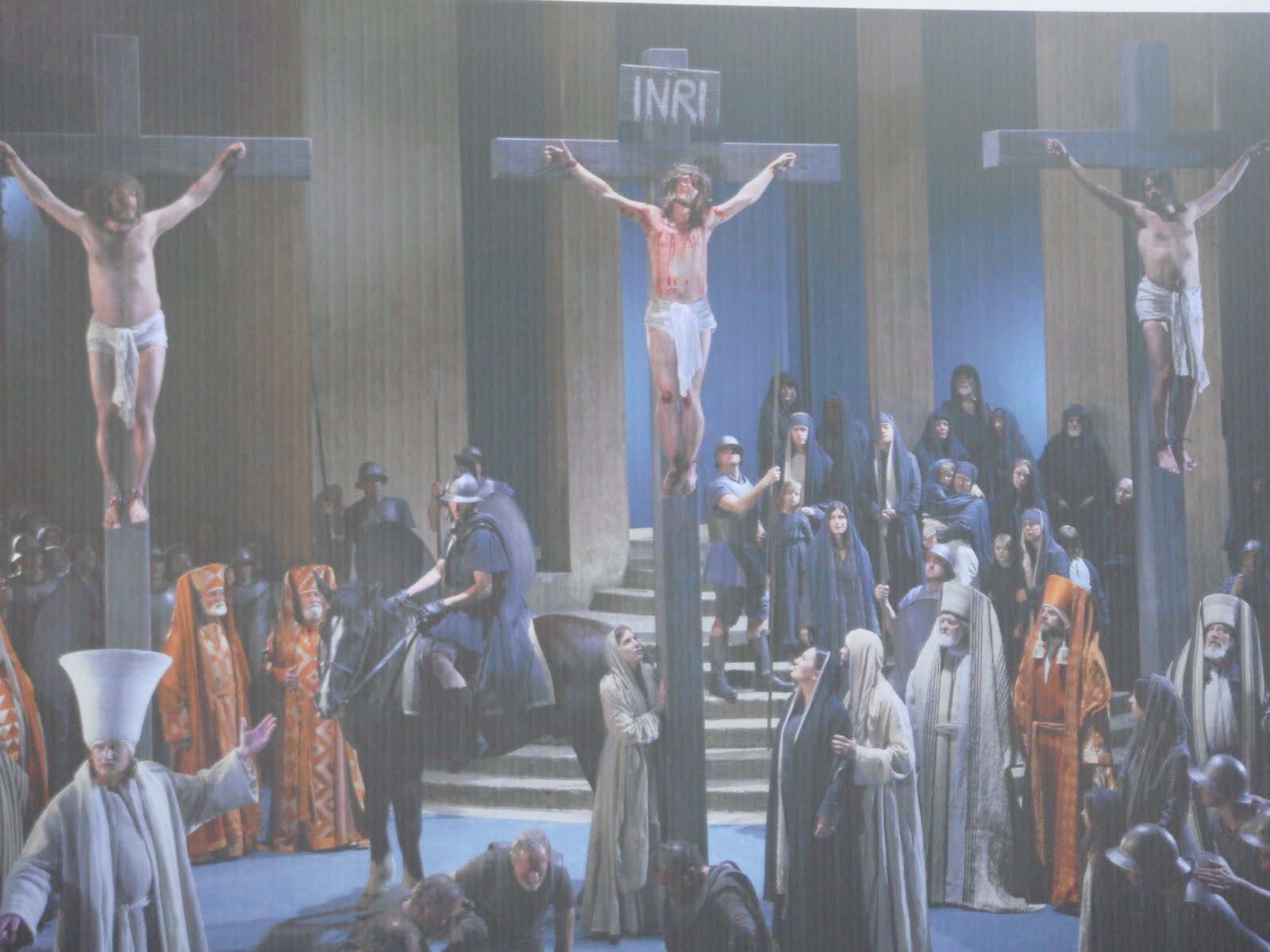
Tableau - The Crucifixion
Oberammergau is a quaint village where the most dominant activity is the Passion play. The play ofcourse is held in 2 parts with a 3 hour break in between during which dinner is served. Everything is so beautifully organised in the true German style of perfection. One has enough time to have dinner, walk around town, shop a bit, visit the museum and take lots of pictures.
A quaint setting
Typical Bavarian
Bronze sculptures everywhere
There was an exhibition of pictures of previous plays held. I found the sets and costumes quite fascinating.
The village is also famous for its woodcarving. The streets of central Oberammergau are home to dozens of woodcarver shops, with pieces ranging from religious subjects to toys to humorous portraits.
Nearest Airport - It is 95 kms from Munich or 75 kms from Innsbruck.
By train - There are hourly trains to Oberammergau Bahnhof from Münich, with a change in Murnau. The journey takes about 2 hours each way. All other major cities in Germany can be reached from Murnau, including Frankfurt in 7 hours.
By bus - There are about four buses per day from Füssen to Oberammergau (fewer in winter). The journey takes 1 hour 30 minutes. An unnumbered shuttle bus connects Oberammergau with the regional train station (RVO Regionalverkehr Oberbayern) at Garmisch-Partenkirchen, from which you can connect to other nearby towns.
By car - The easiest way to reach Oberammergau is by car, which takes about an hour on the autobahn from Münich. Take the A95 Munich-Garmisch-Partenkirchen Autobahn and exit at Eschenlohe. Road 23 connects the autobahn with Oberammergau.
Buying the tickets: Tickets to the play are usually included as part of a larger package comprising of accommodation and sightseeing in some cases.
Oberammergau und DER Reisebüro OHG
Geschäftsstelle Passion 2010
Eugen-Papst-Straße 9a
D - 82487 Oberammergau
Tel. ++49(0)8822-9231 -64
Fax ++49(0)8822-9231 -52
http://www.passionsspiele2010.de/
Subscribe to:
Posts (Atom)